Based on real events. Names, exact dialogue, and minor timeline details have been adapted for privacy, but the numbers, the methodology, and the decisions are the real workflow we run with founders at CITY PROFIT.
In this case study, we walk through a complete business plan for SEO copywriting business built live, from a founder’s personal breaking point to a verified 25-month financial model. The founder is Olia Romanets, a freelance journalist who spent nine years writing under other people’s names before she decided to build something that carried her own. We are publishing the real numbers, the real pricing logic, and the two moments where the first version of her plan simply did not survive contact with the math.
Why Most Freelance Writers Never Build a Real Business Plan for SEO Copywriting Business
Olia started freelancing as a journalism student, picking up work from a marketing agency that paid on time and kept the assignments coming. She wrote fast, researched deeply, a habit from filing stories for her university paper, and clients were consistently happy. Her name never appeared under any of it. That is simply how the industry works: a client buys words, not a byline.
The Ghostwriting Trap
For nine years that arrangement felt normal. Agencies resell anonymous copy constantly, and a writer who never asks for credit rarely finds out where her sentences end up. Olia didn’t either, until a routine scroll through LinkedIn showed her the same “top 5 furniture hardware mistakes” article, word for word, published under three different names on three competing manufacturer sites. One buyer, three invented experts, zero disclosure.
The Moment Everything Changed
That night she made a decision that would become the actual foundation of her business plan for SEO copywriting business: never write anonymously again. If an article is good enough to publish, it is good enough to sign. The idea sounded clean. The numbers, when she finally sat down with CITY PROFIT to test it, did not agree right away, and that disagreement is where the real planning began.
Finding the Niche With City Profit’s Niche and Core Offer Method
A vague idea like “I write good articles” cannot carry a pricing conversation. Using the Niche and Core Offer technology from CITY PROFIT, Olia narrowed her positioning to one sentence: named, research-driven SEO articles for non-technical consumer brands (lifestyle, wellness, education, travel, personal finance) in Ukraine and English-speaking markets, written bilingually.
Narrowing a Broad Idea Into One Sentence
The narrowing mattered because it defined who would never buy from her too. Deep technical fields (chemistry, electronics, regulated pharma copy) were ruled out from day one, both because they sit outside her real expertise and because the value she sells (a trusted human byline) means the least in a category where readers care more about data sheets than voice.
The Core Offer Formula
Her Core Offer, built on CITY PROFIT’s formula, reads: “We write named, research-backed SEO articles for non-technical brands so they stand out with trust and expertise in the age of AI content, even without an in-house journalist.” A second version, aimed at the pitch deck, reframes it as a promise: a brand-voice partner who understands what it costs to publish words nobody trusts.
Pricing With Proof: The POSCO Competitive Analysis
Confidence in a niche means nothing without a defensible price. CITY PROFIT’s POSCO framework scores five real, currently operating competitors on Product, Online presence, Service, brand Cost, and Offline presence, then converts that score into a price range.
Fig. 1: POSCO scores and prices for five real competitors versus Byline Bureau at launch.
What a Business Plan for SEO Copywriting Business Gets Wrong About Pricing
The raw POSCO formula, score times the price of the competitor one rank up, divided by that competitor’s own score, put Olia’s fair launch price at roughly €55 to €70 per article, exactly what an average freelance copywriter already charges, and her entire premise (a signed byline as a trust asset) was about to get priced into the noise of the market average. This is exactly the blind spot a business plan for SEO copywriting business has to catch before a single dollar goes into marketing: so the final price was set deliberately above the formula, at €215 per article, and stated openly why. The package includes something none of the five competitors sell in this form, a public, accountable byline that functions as an E-E-A-T trust signal, not just delivered text.
Rank
Competitor
POSCO score
Price per article
1
Toptal SEO Copywriters
92
€600-900
2
Tyler Tafelsky
81
€410-590 (est.)
3
Zenith Copy
75
€320-500 (est.)
4
Yulia Zima
67
€85-130
5
Iryna Semeniuk
55
€55-85
n/a
Byline Bureau (launch)
52
€215
Table 1: POSCO scores and prices for five real competitors versus Byline Bureau at launch.
The five competitors also drew a clearer picture of her buyer. The strongest fit is a DTC skincare or wellness brand founder running a small team, publishing a blog for SEO, and increasingly worried that competitors with named, human-sounding content are quietly outranking her while her own posts read like every other brand’s AI-assisted copy. A second, equally strong buyer sits inside marketing agencies: a content lead who needs a subcontractor who reliably files clean copy without three rounds of edits, because the agency’s own margin depends on it.
Turning Numbers Into a Business Plan for SEO Copywriting Business That Actually Hits Profit Targets
SUP: The Break-Even Reality Check
CITY PROFIT’s SUP model forces every plan through a break-even test before a single sales channel gets built. Olia’s start-up cost came to €600 (a portfolio site, sole-proprietor registration, a laptop upgrade, a buffer), with fixed monthly costs of €250 once a modest Google Ads budget is included. At €215 per article with an 11% cost-and-tax margin, one single client a month covers the fixed costs. The business was solvent before it had a single sale.
Why a Business Plan for SEO Copywriting Business Needs More Than One Product
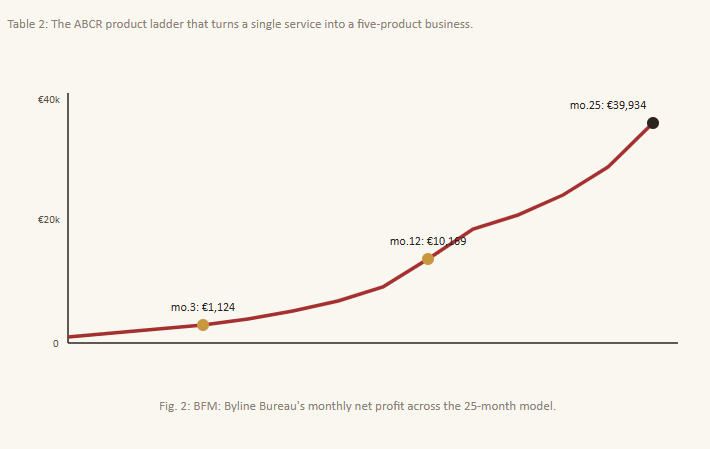
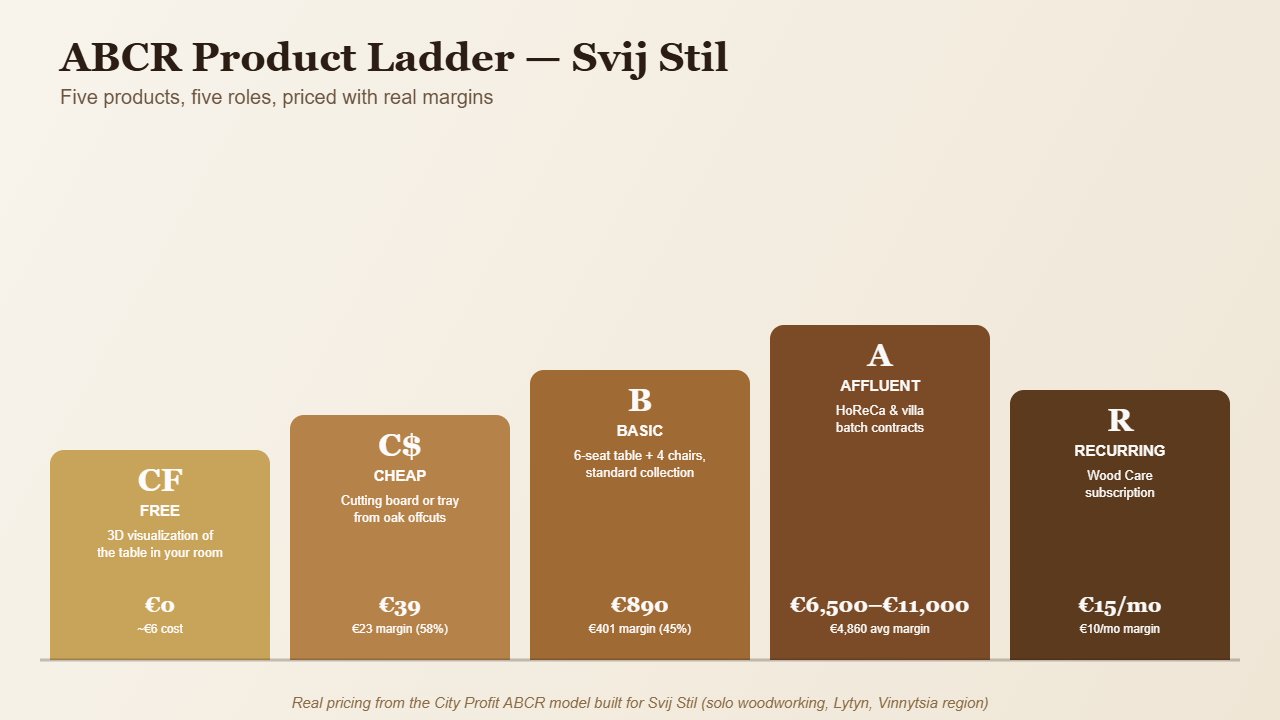
Solvent is not the same as profitable at scale. Running the numbers through CITY PROFIT’s ABCR product ladder (a free CF audit, a low-cost C$ trial article, the core B product, a premium A retainer, and an R subscription) exposed the real ceiling: to reach €10,000 net per month by writing solo, Olia would have needed to personally research and publish more than fifty long-form articles every month. Physically impossible without gutting the quality that makes the whole offer work.
The fix was not to write faster. It was to make the Recurring product, a Byline Bureau Membership at €290 per month, the real growth engine, because a subscribed client base compounds instead of resetting to zero every month. A second adjustment came around month seven: hiring two vetted writers under her own editorial review and final sign-off, so the byline promise stayed intact while the ceiling on solo capacity disappeared.
Fig. 2: The ABCR product ladder that turns a single service into a five-product business.
Product
Role
Price
Margin
CF – SEO E-E-A-T Audit
Free lead magnet
€0
n/a
C$ – Trial named article
Remove risk before B
€45
~€40
B – Named SEO article
Core product
€215
~€191
A – Editorial partnership
Premium, 2-4 clients max
€950/mo
~€665
R – Byline Bureau Membership
Scaling engine
€290/mo
~€235
Table 2: The ABCR product ladder that turns a single service into a five-product business.
Fig. 3: Byline Bureau’s monthly net profit across the 25-month financial model.
The Results: International Metrics and What Comes Next
The financial model behind this business plan for SEO copywriting business is built in a live spreadsheet with real formulas, not typed-in numbers, so anyone can open it, change an assumption, and watch every downstream figure recalculate. By month 12 the plan crosses €10,169 in monthly net profit, ahead of the €10,000 target CITY PROFIT sets as the standard bar. By month 25 the model shows monthly revenue of €49,620 and EBITDA of €42,769, an 86% margin.
Metric
Value
Revenue, month 25
€49,620
EBITDA, month 25
€42,769
Break-even
Month 1
Rule of 40
~309%
CAC and LTV:CAC figures in the full model reflect a deliberately small paid-ads budget (€150/month) and mostly organic acquisition, not a scaled paid-marketing assumption.
Olia’s site and first three portfolio articles are still in progress, and she has not signed a single client yet. The model does not hide that: month one is deliberately shown flat, with no B-product sales, because that is what an honest business plan for SEO copywriting business looks like before marketing has had time to work. What changed is not the calendar. It’s that every article she writes from here carries her real name.
Her first four weeks follow the same roadmap CITY PROFIT builds into every plan: week one is registration, the portfolio site, and three bilingual sample articles; week two is basic SEO setup, the first guest-post pitches, and a modest Google Ads budget; week three is free audits sent to five to ten real prospects; week four is the first paid trial articles and the first core-product sale. None of it depends on luck. It depends on running the sequence in order and trusting the numbers that already survived two rewrites.
Want the same plan for your own idea?
CITY PROFIT builds this exact workflow, niche, POSCO pricing, ABCR product ladder, and a 25-month financial model, for founders across dozens of industries. We’re also putting the underlying templates into a self-serve toolkit at momohero.com (currently in development), where you’ll be able to adapt a ready-made plan yourself or commission a custom draft built around your specific business. Until then, browse more real case studies from CITY PROFIT to see the method applied to other businesses.
Based on real events. Names, exact dialogue, and minor timeline details have been adapted for privacy, but the numbers, the methodology, and the decisions are the real workflow we run…
B2C and B2B Offer template and Development: How a Solo Ukrainian Furniture Maker Reached €10,000 a Month Everything below is based on real events and real technologies working today at…
Go-to-Market · Digital Sales Systems How to Build a Profitable B2B Offer and Go-To-Market Strategy: The Niche, Core Offer, POSCO, ABCR, SUP, and BFM Framework B2B founders don’t fail because…