B2C and B2B Offer template and Development: How a Solo Ukrainian Furniture Maker Reached €10,000 a Month
Everything below is based on real events and real technologies working today at City Profit, a developer and integrator of sales systems for small and medium business. This is the story of how B2C and B2B offer template we use and development turned one solo woodworking workshop in Ukraine into a business earning €10,000 a month in net profit within eleven months, and why we now use it as a working example whenever a founder tells us they only have one type of customer.
From a Rescued Oak Beam to a Dining Table With History
Stepan spent fifteen years as a construction foreman in Lytyn, a small town in the Vinnytsia region, fixing roofs and pouring foundations by day and teaching himself woodworking by night.
Fifteen Years as a Foreman, Self-Taught by Night
In 2024, a hundred-year-old house nearby was demolished, and Stepan pulled two solid oak beams out of the debris pile before they went to a bonfire. Over two months of evenings he turned them into a dining table for his own kitchen, leaving the old nail marks visible on purpose, as part of the wood’s history rather than a flaw to sand away.
The Neighbor Who Turned a Hobby Into an Order
A neighbor saw the table, asked if Stepan could build a smaller version for her dacha, and offered to pay for it. That single request is the entire origin of what became Свій Стіл (“Your Own Table”). Our team at City Profit hears a version of this story constantly: a skilled person builds one great thing, somebody offers money for a second one, and suddenly there is a business question nobody planned for. We use our own b2c and b2b offer template to build a go-to-market (GTM) strategy to continue this journey. Come along.
Why Full Custom Furniture Failed the Numbers
The first instinct, and the most common one we see, was to keep doing exactly what worked: fully bespoke, one-off tables and chairs, priced case by case. We at City Profit ran this version through our POSCO pricing technology against five real competitors in the market, and the price looked defensible. The problem showed up later, once we modeled the business past its first few sales.
SUP Breakeven Looked Fine on Paper, but our b2b offer template says….
The SUP (start-up point) math for pure custom furniture actually worked: with total starting costs of roughly €4,390 and monthly fixed costs near €610, Stepan only needed about two orders a month to break even. On a spreadsheet, that looked like a safe, low-risk way to start.
The BFM Ceiling: One Master, One Piece at a Time
The trouble appeared when we ran the full 25-month BFM (business financial model) forward. A single master building fully custom pieces from scratch, with no repeatable templates, physically cannot produce enough furniture to reach €10,000 a month in net profit by month twelve, no matter how the price or the marketing channel is adjusted. Custom work has a hard production ceiling that no amount of demand can fix.
The Standard Collection: Iteration Two, Still Short of the Goal
The second version replaced one-off custom pieces with a three-design standard collection, built in small batches from repeatable templates instead of starting from zero each time. This alone was a meaningful improvement.
Three Designs, Batch Production, Still a Retail Ceiling
Batch production got the €1,000-a-month net profit goal within reach by month three. But selling one table at a time to individual homeowners, through a single retail channel, still capped growth well below €10,000 a month by month twelve. There was no second revenue stream and no team to share the workload, so the business simply ran out of hours in the month.
The Café Order That Changed Everything: Discovering B2C and B2B Offer Development
The breakthrough came from a chance conversation with a friend opening a small café, who needed twelve tables and forty chairs in one matching style, delivered on a deadline, with consistent quality across every piece. Neither of the first two versions of the business was built to serve that kind of order.
Twelve Tables, Forty Chairs, One Deadline
A batch order of that size is a fundamentally different sale from a single table for a family dining room: different buyer, different budget, different decision process, and a very different tolerance for delay. It forced a question the business had never asked: who exactly is buying, and why?
Why B2C and B2B Offer template and development need two separate Playbooks
Applying City Profit’s POSCO technology (part of b2c and b2b offer template and gtm strategy framework) to re-examine the customer portrait revealed two clearly different buyer types hiding inside “furniture customers”: private homeowners buying one table for their own home, and hospitality business owners buying in bulk and paying a premium for reliability and speed. That split is the actual starting point of B2C and B2B offer development for this business, and it is the moment the numbers finally started moving in the right direction.
POSCO: Pricing Against Real Competitors, Not Guesswork
Our team regularly sees founders price furniture by gut feeling, either too low to survive or too high to compete. POSCO exists to replace that guess with a defensible number.
Five Real Competitors, One Defensible Price of €890
City Profit scored Svіy Stіl’s core table against five real competitors in the region: New Wood, Woodville, Тесляр, the Polish brand Stół Poproszę, and Sobi. That analysis via b2c and b2b offer template put the reference price for a single comparable table at €506. The final Basic-tier price of €890 is justified because it bundles four matching chairs, a coordinated design, and a two-year warranty, delivering more value than the single-table comparison point while remaining fully defensible against the competitive set.
Two Very Different Buyers: The Foundation of b2c and b2b offer template and development
Once the café order exposed the split, we built out both customer portraits properly rather than treating “furniture buyer” as one audience.
Marina: The Homeowner Who Compares You to IKEA
Marina is 34 to 45, lives in a suburb or regional city in Ukraine, has an above-average household income, and finds Svій Stіl through search, ads, or Instagram. She takes two to four weeks to decide, and her biggest hesitation is trusting an unverified craftsman and comparing the price against mass-market furniture.
Oleg: The HoReCa Owner Who Pays for Reliability
Oleg runs a café, restaurant, or boutique hotel with 5 to 40 staff. He is found mainly through referrals from interior designers and architects, plus Google Maps and ads. His decision cycle runs one to three months, and his biggest objection is whether a one-person workshop can actually deliver a large batch order on time, at consistent quality.
How B2C and B2B offer template by CITY PROFIT Development Change the Sales Conversation
Marina and Oleg do not respond to the same message. Marina needs to see craftsmanship, warmth, and trust signals. Oleg needs proof of capacity, a delivery timeline, and references. Running B2C and B2B offer development as two explicit tracks, rather than one generic pitch, is what let Svій Stіl sell confidently to both without diluting either message.
GTM Strategy for Ukrainian Furniture Business in Europe: Channels That Bring Marina and Oleg
A go-to-market plan only works if it is built around how each buyer actually finds you. This is the core of the GTM strategy for Ukrainian furniture business in Europe that City Profit put together for Svій Stіl, covering both Ukraine and nearby EU border markets such as Poland, Slovakia, Hungary, and Romania.
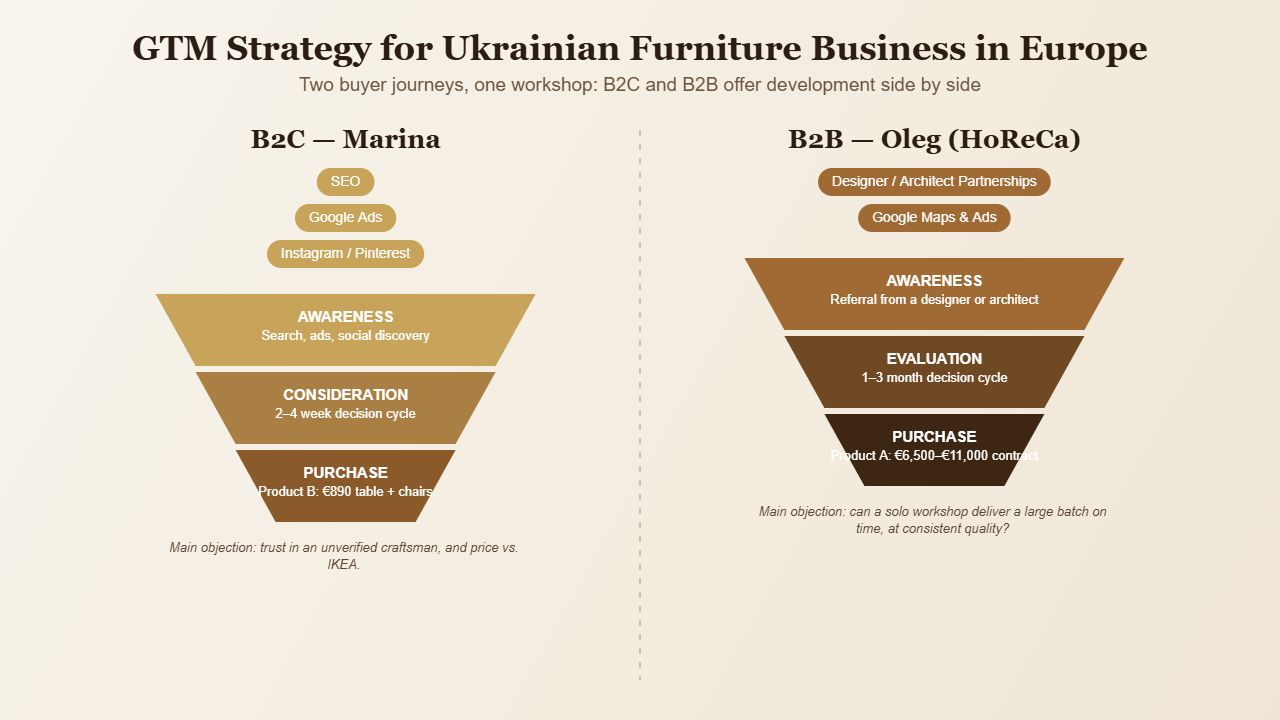 Two buyer journeys inside one GTM strategy for Ukrainian furniture business in Europe: Marina’s search-and-social path on the left, Oleg’s partnership-driven path on the right.
SEO, Google Ads, and Instagram: Reaching Marina
For the B2C side, three channels do most of the work: search engine optimization around practical, high-intent queries; Google Ads for buyers already comparing options; and Instagram and Pinterest for the visual, aspirational browsing that leads homeowners to a craftsman like Stepan in the first place.
Designer and Architect Partnerships: Reaching Oleg
For the B2B side, the single most valuable channel is partnerships with interior designers and architects who are already specifying furniture for hospitality projects. Google Maps and targeted ads support this, but the designer relationship is what actually opens the door to a €9,000 average contract, because it arrives pre-qualified and pre-trusted.
Partnerships as the Core of a GTM Strategy for Ukrainian Furniture Business in Europe
Any GTM strategy for Ukrainian furniture business in Europe that ignores designer and architect partnerships is leaving the highest-value channel unbuilt. It is slower to set up than running ads, but once two or three designers trust the workshop’s quality and delivery record, referrals become a predictable, low-cost source of exactly the batch orders that make the ABCR model work. You can read more about how City Profit builds channel strategy for founders in a similar position.
ABCR: Building a Product Ladder from Free Visualization to Premium HoReCa Contracts
ABCR is City Profit’s framework for turning one core product into a full ladder that captures value from a curious first-time visitor all the way up to a premium recurring client.
The Logic of an ABCR Ladder
Instead of one fixed offer, each rung of the ladder plays a distinct role: lowering the barrier to a first interaction, converting that interest into a small first purchase, delivering the core product, capturing the highest-value contracts, and finally turning past clients into a source of recurring revenue.
Five Products, Five Roles, Priced With Real Margins
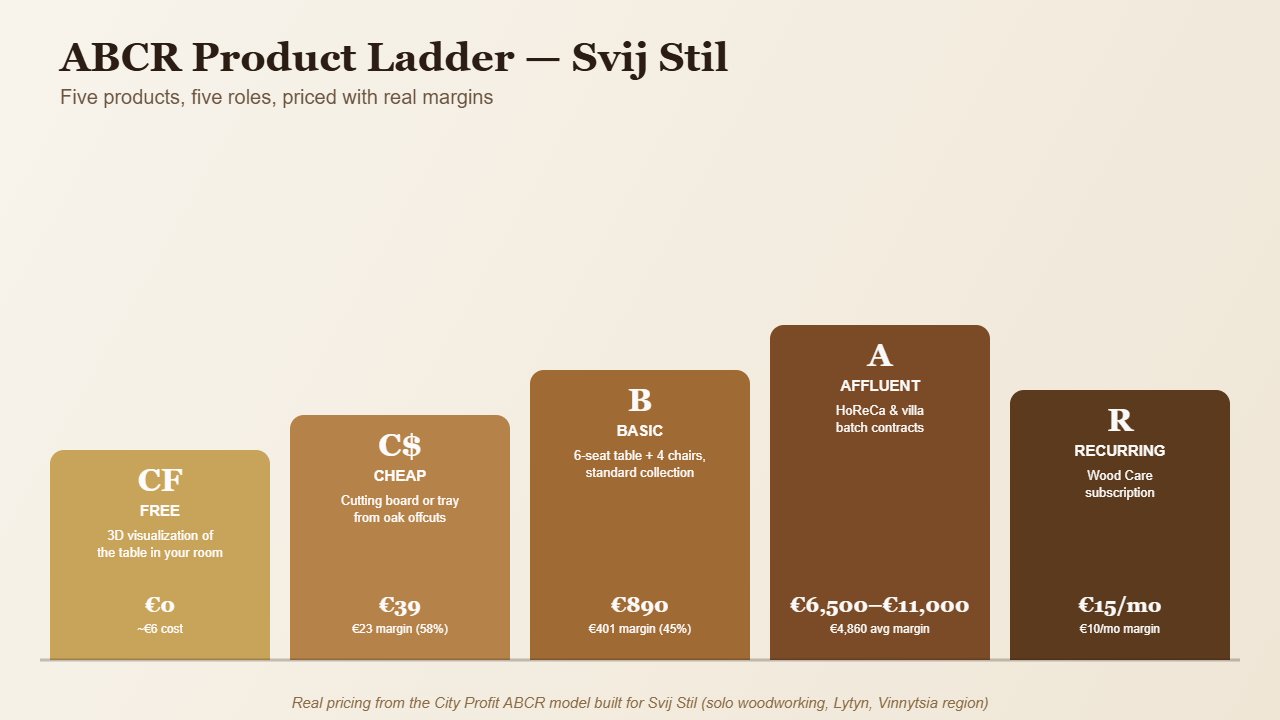 The full ABCR ladder built for Svіy Stіl, with real prices and margins from the City Profit financial model (a part of b2b offer template).
CF (Free) — 3D Visualization
A free 3D visualization of a table placed inside the client’s own room, generated from a photo. It costs the business about €6 in the master’s time and exists purely to remove the risk of imagining an unfamiliar piece of furniture in a real space.
C$ (Cheap) — Offcut Cutting Boards and Trays
A cutting board, tray, or small stool made from oak offcuts, ready in three to five days. Priced at €39 against a cost of €16, this is a low-risk first purchase that turns a visitor into a paying customer with almost no added production time.
B (Basic) — The Table-and-Chairs Bundle
The core product: a six-seat table with four matching chairs from the standard collection, priced at €890 against a cost of €490, a €401 margin. This is the product B2C and B2B offer development is built around for Marina.
A (Affluent) — HoReCa and Villa Batch Contracts
Batch contracts for cafés, restaurants, and villas, typically around twelve tables and forty-five chairs for a 40-to-50-seat venue. Deals range from €6,500 to €11,000, averaging about €9,000, with a cost of roughly €4,140 and a margin near €4,860. This is the product built for Oleg.
R (Recurring) — Wood Care Subscription
A “Wood Care” subscription, sold to past B and A clients, combining a quarterly care kit with an annual on-site inspection for about €15 a month, roughly €10 of it margin. It monetizes the existing client base with almost no extra time from the master.
SUP: Finding the Breakeven Point Before Scaling
Before committing to any marketing spend, City Profit always calculates the SUP, the exact point at which the business stops losing money.
Why B2C and B2B Offer Development Needed a Breakeven Check First
With total starting costs of €4,390 and monthly fixed costs of €610, Svій Stіl needed just two Product B sales a month to break even. Knowing that number gave Stepan the confidence to invest time in designer outreach and paid channels before a single HoReCa contract had closed, because the downside was already small and quantified rather than a leap of faith.
BFM: The 25-Month Model Behind B2C and B2B Offer Development
The BFM is where every earlier decision, the pricing from POSCO, the ABCR ladder, and the two-track GTM plan, gets tested against twenty-five months of real cash flow, staffing, and demand.
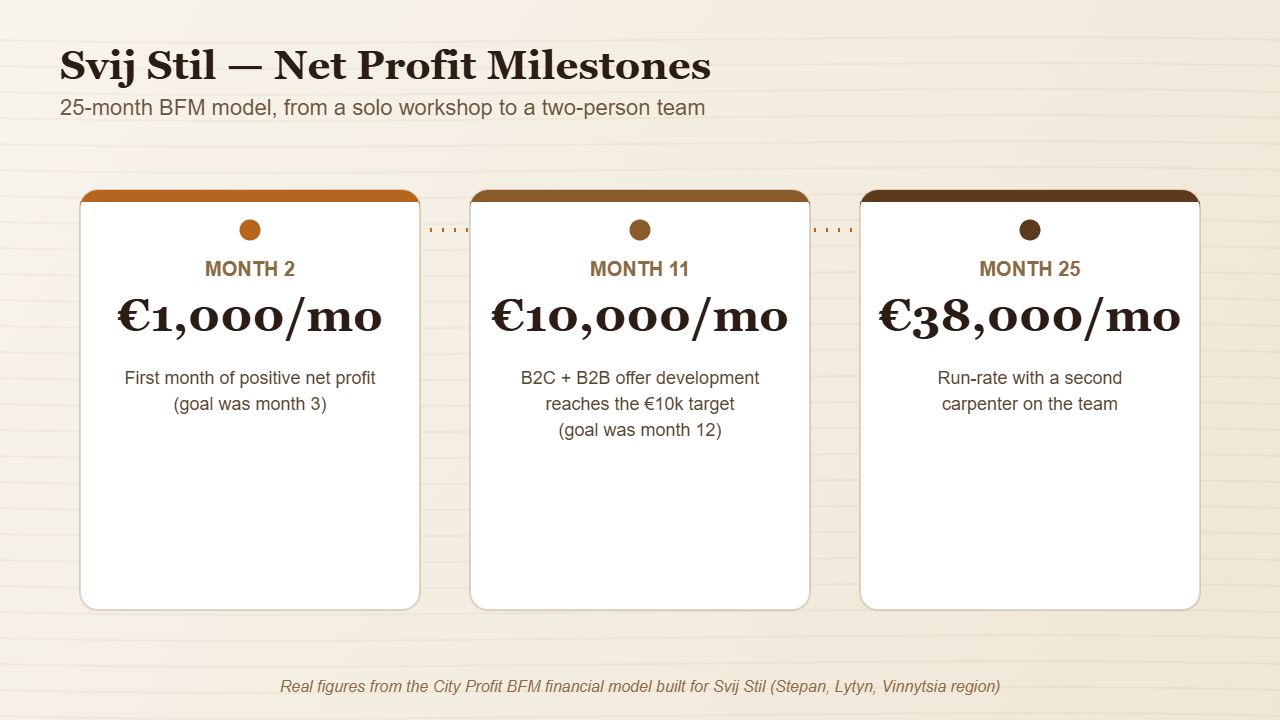 Net profit milestones from the 25-month BFM model built for Svій Stіl.
Month 2 and Month 11: Beating Both BFM Targets Through B2C and B2B Offer Development
The model reached €1,000 a month in net profit in month two, ahead of the month-three goal, and crossed €10,000 a month in net profit in month eleven, a month ahead of schedule. That acceleration only happened once B2C and B2B offer development was running as two coordinated tracks instead of one undifferentiated sales motion.
Month 25: A €38,000 Run Rate and a Two-Person Workshop
By month twenty-five the model projects a run rate near €38,000 a month. The team grows with the model: Stepan works alone through month five, adds a part-time sales and logistics assistant in month six, and brings on a second contract carpenter in month ten to keep up with growing HoReCa batch volume. Along the way the model tracks a customer acquisition cost near €45 against a lifetime value near €634, an LTV-to-CAC ratio of roughly 14 to 1, and recurring monthly revenue from the Wood Care subscription reaching €1,732 by month twenty-five.
A Practical Roadmap for Your Own GTM Strategy for Ukrainian Furniture Business in Europe
If you make or sell a physical product in Ukraine and sell across the border into the EU, the sequence that worked for Svій Stіl is worth copying directly rather than reinventing.
A Step-by-Step Roadmap for Your Own GTM Strategy for Ukrainian Furniture Business in Europe
Step 1–3: Validate the Price and the Breakeven
- Score your core product against real competitors instead of guessing a price.
- Calculate your SUP breakeven before spending on any channel.
- Batch or template your production so one order does not require starting from zero.
Step 4–6: Split Your GTM Strategy for Ukrainian Furniture Business in Europe by Segment
- Build separate customer portraits for individual buyers and business buyers, even if today they feel like one audience.
- Put SEO, paid search, and social channels behind the individual-buyer offer.
- Invest in designer, architect, or industry-partner relationships for the business-buyer offer, since referrals convert faster than cold outreach.
We at City Profit build this exact sequence for founders across very different products, and you can explore other City Profit case studies to see how the same POSCO, ABCR, and BFM methodology applies outside furniture.
What Does B2C and B2B Offer Development Mean for a Small Manufacturing Business?
It means building two distinct offers, price points, and sales messages for individual consumers and for business buyers, instead of selling one generic product to everyone. For Svій Stіl, that meant a €890 table-and-chairs bundle for homeowners and a €6,500–€11,000 batch contract for hospitality businesses.
How Long Did It Take Svій Stіl to Reach €10,000 a Month in Net Profit?
Eleven months, one month ahead of the twelve-month goal in the original BFM plan. The business had already reached €1,000 a month in net profit by month two.
What Is the ABCR Product Ladder and Why Does It Matter for a Solo Maker?
ABCR stands for Free, Cheap, Basic, Affluent, and Recurring: five product tiers, each with a specific job in the sales funnel. For a solo maker it matters because it spreads revenue across low-effort and high-value products instead of relying on one price point to cover every cost.
How Does City Profit’s POSCO Technology Set a Defensible Price?
POSCO scores your product against a set of real, named competitors on the factors buyers actually compare, then anchors your price to that analysis instead of a guess. For Svій Stіl, that meant comparing against five real furniture makers before setting the €890 core price.
What Is a Realistic GTM Strategy for Ukrainian Furniture Business in Europe on a Small Budget?
Start with SEO and organic social for individual buyers, since both are nearly free, then reinvest early profit into a small paid-ads budget and into building two or three designer or architect relationships, which is the highest-leverage channel for business buyers.
Can One Master Really Serve Both B2C and B2B Offer Development at the Same Time?
Yes, but only once production is templated rather than fully custom, and only with a plan to add help as batch orders grow. Svій Stіl stayed solo through month five, then added a part-time assistant and, by month ten, a second carpenter.
What Is SUP and Why Calculate It Before Scaling?
SUP is City Profit’s start-up point calculation: the exact number of core-product sales needed each month to cover starting and fixed costs. Svій Stіl needed two Product B sales a month to break even, a number known before any marketing spend began.
How Did the Wood Care Subscription Add Recurring Revenue?
Past clients pay about €15 a month for a quarterly care kit and an annual on-site inspection, adding predictable revenue from an existing customer base with almost no additional production time from the master.
What Does the BFM 25-Month Financial Model Actually Predict?
It projects monthly revenue, costs, and net profit across twenty-five months, including staffing changes, and for Svій Stіl it predicted €1,000 a month net profit by month two, €10,000 a month by month eleven, and a run rate near €38,000 a month by month twenty-five.