TAM, SAM, SOM and international metrics: the numbers an investor reads first
A bottom-up TAM SAM SOM count, the real International Metrics tab from our own model with a legend, and a SAFE calculator for the ask.



Disclosure: City Profit builds the ABCR method and sells services based on it. The restaurant below is an invented teaching example. The spreadsheet tab further down is copied from our own financial model.
ABCR splits what you sell into four products with four different jobs. C is a cheap first purchase. B is the main product. A is the expensive product with the fat margin. R is a subscription that renews without new advertising. A restaurant shows it better than any definition.

Picture Vesper Table, a restaurant with five tables in a town of 80,000 people. It sells one thing: dinner for two at about €90. Two seatings a night, 26 evenings a month. A full house every evening brings €23,400 of revenue.
That number is the ceiling, and the chairs set it. Rent, wages and ingredients take most of it. The owner works at full capacity and the business still cannot grow.
ABCR starts at exactly this wall. When one product has a ceiling, you add products that do not fight for the same chairs.

€6
Sold from a hatch by the door, 8:00 to 11:00. It takes no chair. Its job is the first yes: a stranger tastes the kitchen for the price of a bus ticket and leaves with a QR code for the Saturday list.

€90
The restaurant itself: a couple at the table, the waiter, the wine. Its job is to pay the bills and make the place real. Its capacity is five tables, and that is where the ladder begins.

€6,000
The same kitchen and the same promise, delivered at scale on a Monday when the room is empty. One A equals about 67 dinners for two and covers half a month of fixed costs (€12,000 in this example).
€39 / month
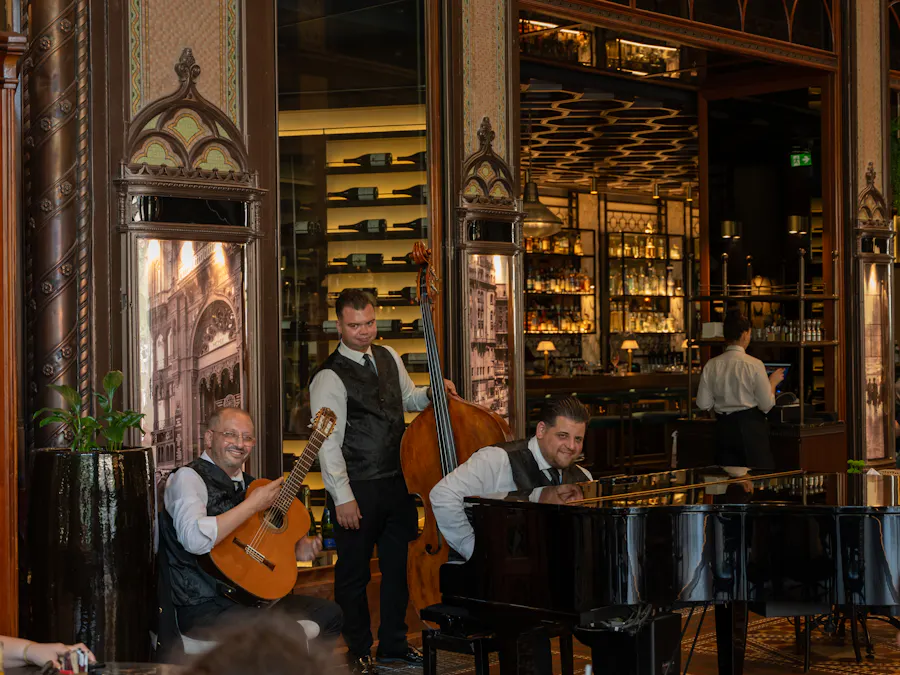
One members-only Saturday a month: live music, a set menu and your own table, billed monthly for a year. Its job is income that arrives without advertising. A hundred members pay €3,900 a month before anyone opens the door.
A staircase suggests that everyone climbs from the bottom to the top. Real customers do not. Circles show it better: the size follows the price, and the overlaps show where people move between products.
Circle size follows price. R sits on the overlap of A and B because members book weddings and members also eat dinner.
Below is the ABCR tab of the financial model we built for our own product, Momo Hero. Five columns, five jobs. The restaurant is a story, this is the working document.
| A | B | C | D | E | F | |
|---|---|---|---|---|---|---|
| 2 | Field | CF | C$ | B | A | R |
| 3 | Core Offer1 | We give a real investor-grade plan example for the price of a coffee, so a founder sees the quality bar without paying full price. | We give a full example business plan and pitch deck as a PDF, so a founder understands the whole submission structure in one evening. | We give a pack of editable originals (plan, 25-month model, deck, Story Mode), so a founder assembles a submission-ready pack in a day, with no finance background. | We build serial founders a full pack for one specific investor (deck, plan, model, website, and 1,000 live visitors/month), so they walk into the meeting with a project that already looks alive. | We build a custom pack around the client’s own idea and their specific grant or investor, so they submit an agency-grade document without paying full price again for each new round. |
| 4 | Price2 | 0 EUR | 8 EUR | 92 EUR | 4630 EUR (3 tranches: USD 2000/1000/2000) | 462 EUR |
| 5 | Emotional read3 | Removes the fear of “what is even supposed to be in this document” | Gives the feeling “I now have a benchmark to aim at” | Confidence to submit an agency-grade document at template price | Confidence to walk into an investor meeting with a live project, not a promise | Removes the stress of going through the whole process from scratch again |
| 6 | Margin4 | ≈0 EUR | ≈8 EUR | ≈86 EUR | ≈3704 EUR (80%) | ≈393 EUR (85%) |
Change the numbers and watch what the tail does. Defaults describe Vesper Table: 600 new people a month reach the door.
Vesper Table: dinner only or the full ladder?
Teaching numbers, not a forecast. Replace them with yours.
Revenue for R counts price x months a member stays. The model for your own business lives in the BFM.
Five prices for the same thing. Small dinner, medium dinner, large dinner. The buyer is the same, the fear is the same, and the ladder is only a price list.
A before B. A wedding menu on the website of a place nobody has tasted.
Different products for different fears. Coffee answers “is it any good”. Dinner answers “is it worth an evening”. The wedding answers “can I trust them with the biggest day”.
B first, A when B has a queue. Evidence travels upward from the cheap products.
Most ladders fail at R, not at A. Founders find it easy to imagine a big sale and hard to imagine a customer who pays every month without being asked. Start your design from R: ask what your buyer needs again and again.
Master Director students build this ladder for their own idea in the course at mdopen.pro. If you would rather have a finished website and a business built around a ladder, look at Cab1.
The City Profit technologies series
Previous: SUP | Next: BFM | Overview: the seven-step go-to-market guide | All technologies
C is the cheap first product, B is the main product, A is the expensive high-margin product and R is a subscription that renews without marketing. In our models a free product, CF, sits in front of C$.
No. Start with B, add C$ next, then R, and add A when B has a waiting list. A ladder with two solid steps beats one with four weak ones.
An upsell sells more of the same thing to the same buyer. ABCR products serve different buyers with different fears, so each one can be bought on its own.
Score B against competitors with POSCO, check the fixed costs with SUP, anchor A to the cost of the buyer doing it alone, and price R by the value of one month.
Yes. A consultant can sell an audit as C$, a project as B, a retainer as R and a program rebuild as A. A software company can use a template pack as C$ and a team plan as B.
Want this done on your numbers? Book a free 30-minute audit with Volodymyr Pimenov.
Book the free auditSee City Profit services