Go-to-Market · Digital Sales Systems
How to Build a Profitable B2B Offer and Go-To-Market Strategy: The Niche, Core Offer, POSCO, ABCR, SUP, and BFM Framework
B2B founders don’t fail because their go-to-market strategy is bad. They fail because nobody forced them to go through these seven uncomfortable but important steps before posting on LinkedIn or Instagram, before they spent money on ads, a website, or a sales hire.
This is the exact sequence City Profit runs for every founder who comes to us with an idea and leaves with an investor-ready pitch deck and proper financial model: explained step by step, with a real worked example.
Why most B2B offers fail before they even launch
Founders rarely fail at execution. At sequencing they fail. Copywriters write ad copy before knowing their niche, big bosses set a price before checking the market, and pick marketing channels before they know where their buyer actually spends time. Each of those decisions is reversible on its own – but stacked together, they turn into months of wasted budget and a business that “should” work but doesn’t convert.
The Real Cost of Guessing a go-to-market strategy Instead of Testing
A guessed price is either too low to sustain a team or too high to justify relative to competitors’ clients already trust. A guessed channel means paying for reach in front of people who were never going to buy. A guessed niche means an offer nobody can repeat to a colleague, team, or investor in twenty seconds – and if they can’t repeat it, they won’t refer it. Every framework below exists to replace one specific guess with one specific number.
Step 1: Finding a B2B Niche That Actually Sells
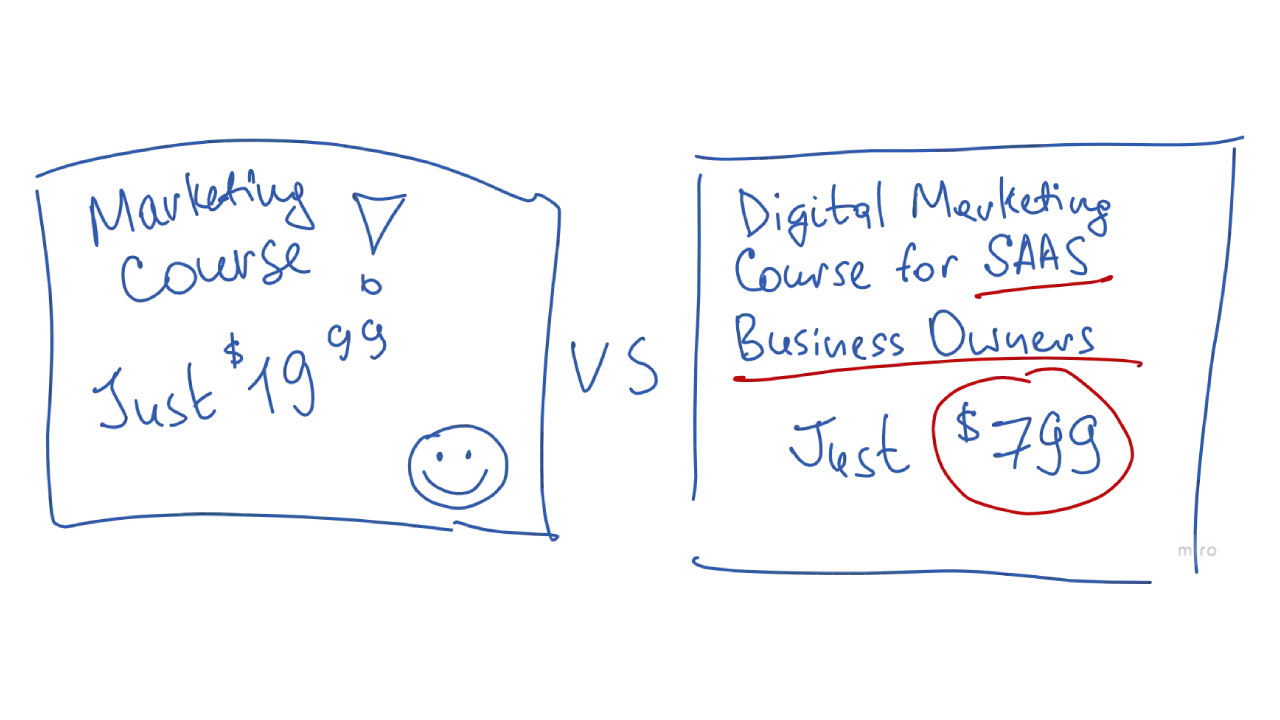 A niche is not a job title or a product category. A real niche answers three questions at once: what you sell, who you sell it to, and what specific problem you solve that nobody else owns as clearly as you do. “Marketing agency” is not a niche. “Paid acquisition for ERP SaaS founders selling to small but national retailers” is.
What a Real Niche Answers (and a Product Category Doesn’t)
The narrower the niche, the deeper the expertise, the higher the price you can charge, and the easier the business is to explain, grow your team via SOP, staff and scale. Founders resist narrowing because it feels like leaving money on the table. In practice, the opposite happens: a founder who serves everyone ends up competing on price with everyone, while a founder who owns one specific buyer’s specific problem becomes the obvious call.
How to Validate Demand Before You Build Any GTM
Before a single line of code or a single ad dollar is spent, the niche has to clear two cheap, fast tests.
1. Search and Keyword Signals before go-to-market strategy
If competitors are already running ads against your target keywords, that is a good sign, not a bad one — it means a market exists and is willing to pay to reach it. No ads and no organic results at all usually means no demand yet, not an untapped goldmine.
2. Pre-Sales as the Ultimate Validation instead of wasing time on theoretical GTM
The fastest way to validate a niche is to ask three real prospects to pay before the product fully exists. If nobody will commit even a small deposit, the niche isn’t proven yet — no amount of branding will fix that at launch.
Step 2: Engineering a Core Offer People Can Repeat in 20 Seconds
Your Core Offer is the one sentence your business is known for. It is not your full catalog, your service menu, or your mission statement — it’s the single promise that pays the bills and the one thing a client should be able to repeat to a colleague without your help.
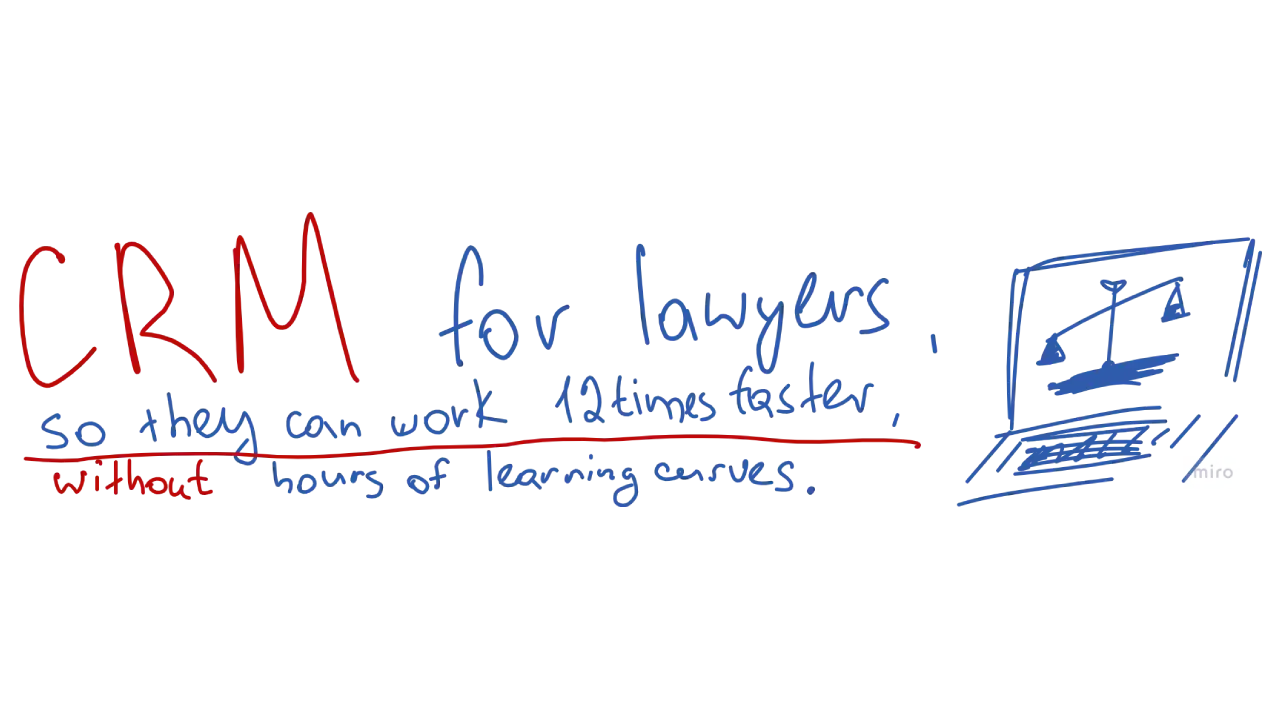
The Core Offer B2B Formula by CITY PROFIT
City Profit builds every Core Offer around one structure: “We do [X] for [Y], so you can [Z], even without [A].” The “even without A” clause is the part founders skip — and it’s usually the part that actually differentiates the offer from every competitor saying roughly the same thing about X, Y and Z.
Why “Without X” Is the Hardest Word to Write
Naming the objection your buyer is silently holding — no budget, no time, no technical team, no local presence — forces you to design the product around removing that specific friction, instead of just describing what you do.
Turning the Formula Into Two Sentences
A strong Core Offer ships in two versions: one describing the transaction (“we built X for Y”) and one describing the outcome in the buyer’s own emotional terms. Investors and buyers respond to different halves of the same sentence — the deck needs both.
Technical Framing vs Emotional Framing
The technical version answers what’s included, what’s excluded, and what it costs. The emotional version answers what changes in the buyer’s life or business once the problem is gone. Skipping either one leaves half the room unconvinced.
Step 3: Pricing With POSCO Instead of Guesswork
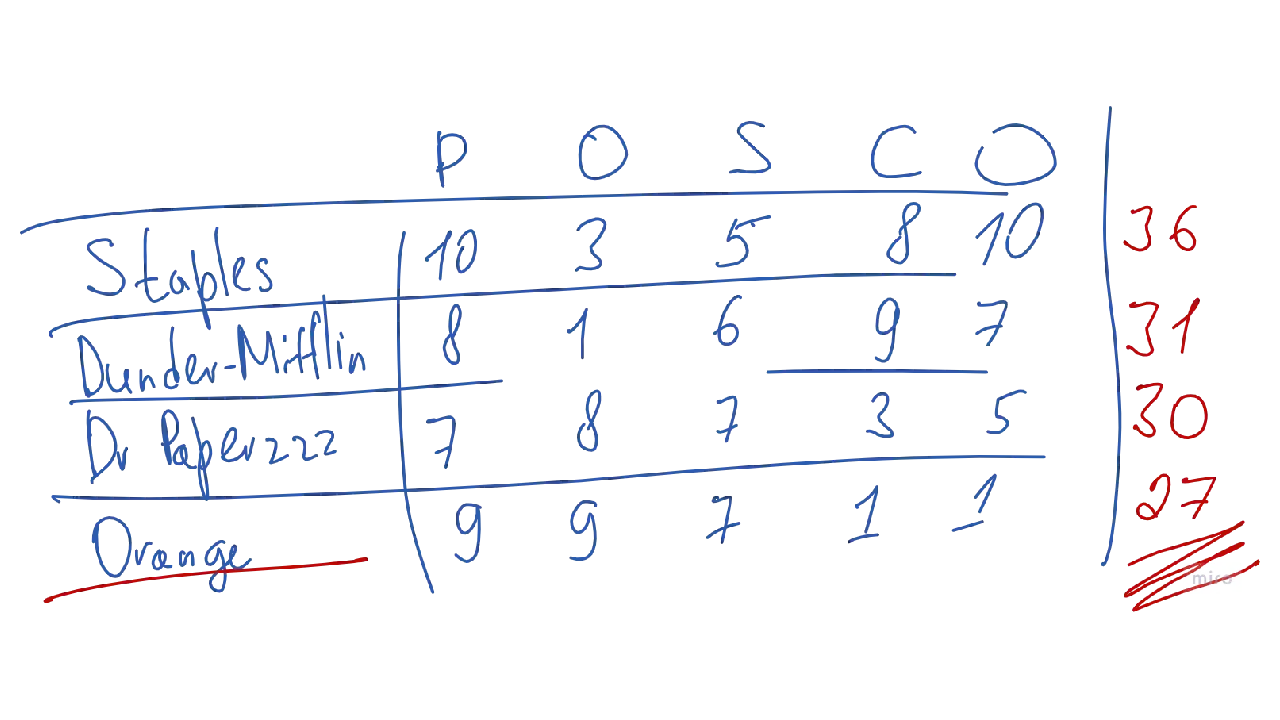
POSCO is City Profit’s competitive scoring system: Product, Online presence, Service, Cost (brand equity), Offline presence. Instead of pricing based on what feels fair, POSCO scores every real competitor and your own offer against the same five weighted criteria, then checks whether price correlates with score across the market.
 The Five POSCO Pillars
Not every pillar carries equal weight in every niche — a B2B service business should weight Product and Service heavily, while a consumer packaged good should weight Cost, meaning brand strength, far higher.
1) Product
The full value delivered to the buyer, not just the feature list — outcomes, guarantees, and what happens after the sale.
2) Online
What a prospect finds about you before they ever talk to a human: your site, your SEO position, your reviews, your case studies.
3) Service
Response speed, communication quality, and how objections are handled — often the fastest lever a new business can improve, long before it can out-brand an incumbent.
4) Cost — Brand Equity
Not your price — the trust premium your name alone commands. A known founder or a recognizable logo can move this score independently of the product itself.
5) Offline
Physical presence: office, storefront, signage, materials — weighted heavily for local and retail businesses, and close to irrelevant for a fully remote B2B service.
Scoring Your Competitors Honestly
Score four or five real competitors on the same scale, then plot their total score against their public price. In a reasonably efficient market, higher scores correlate with higher prices – and that correlation is what turns your own score into a defensible number instead of a hopeful one. YOU CAN NOT come up with good go-to-market strategy without honest scoring here.
What to Do When POSCO Tells You to Lower Your Price
This is the moment most founders resist the framework. A new brand with no reviews and no case studies will always score lower than an incumbent on Cost and Service, and the honest math often lands below what the founder wanted to charge. The right response isn’t to ignore the score — it’s to bundle in value competitors don’t offer at all, so the price is justified by scope, not by brand strength you don’t have yet.
Step 4: Building an ABCR Product Ladder So One Offer Doesn’t Carry the Whole Business
ABCR is City Profit’s product-line architecture: a Free lead magnet, a low-ticket trust builder, a Core offer, and a Premium or Recurring layer on top. It exists because a single product almost never has enough margin to fund both acquisition and operations on its own.
 The Four Layers of the ABCR Ladder
Each layer has a different job in the funnel — trust, commitment, revenue, and retention — and each one should be designed on purpose rather than added later as an afterthought.
CF — The Free Lead Magnet
A checklist, mini-audit, or short call that removes the buyer’s first fear and captures a real contact, at close to zero marginal cost.
C$ — The Low-Ticket Trust Builder
A small paid step — an audit, a diagnostic, a starter package — that turns a lead into a paying customer before they’ve committed to the full offer.
B — The Core Offer
Your main revenue engine, priced and justified using POSCO, built to run at healthy gross margin on its own.
A and R — Premium and Recurring Revenue
A premium bundle for buyers who want everything solved at once, and a recurring layer that keeps revenue flowing after the main transaction closes.
Why a Thin Margin Signals a Missing Product, Not a Bad Idea
When a break-even model comes back too tight, the instinct is to cut cost or raise the core price past what the market will bear. Usually the better fix is a new layer in the ladder — a premium tier for the buyers who’d happily pay more, or a recurring add-on that turns a one-time sale into a relationship.
Step 5: Proving the Model With SUP Break-Even Math
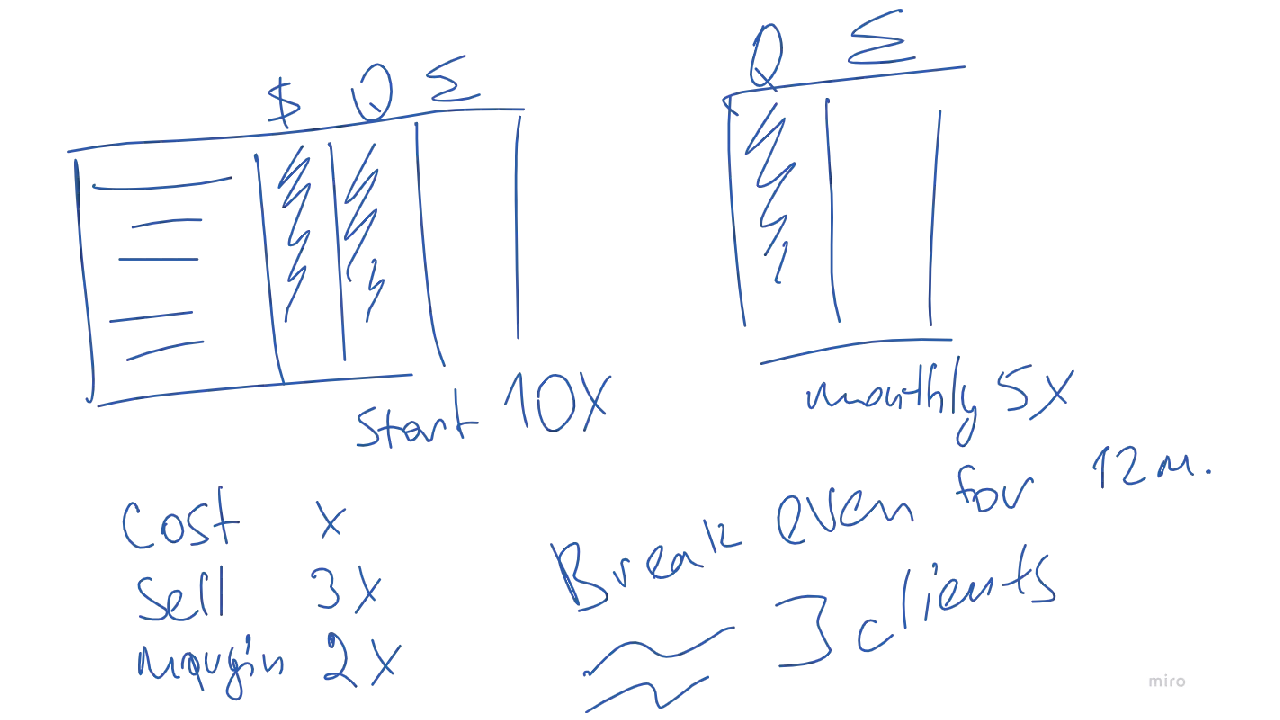
SUP is the break-even model behind the pitch deck: start-up costs, fixed monthly costs, target payback period, and the resulting margin per unit sold. It answers one specific question a spreadsheet full of assumptions usually hides — how many customers, exactly, do you need this month to stop losing money?
 What SUP Actually Calculates
SUP takes your one-time launch costs and your recurring monthly costs, divides them by your target payback period, and compares the result to the margin on a single sale. The output is a single number founders remember long after the meeting ends: “we need N customers a month to break even.”
Fixed Costs vs Flex Costs
Fixed costs — team, tools, subscriptions — don’t move with sales volume. Flex costs — cost of goods and taxes — scale with revenue. Separating the two is what makes the break-even number honest instead of optimistic. Now you are much closer to real-world go-to-market strategy.
Step 6: Choosing Channels Your Buyer Actually Uses
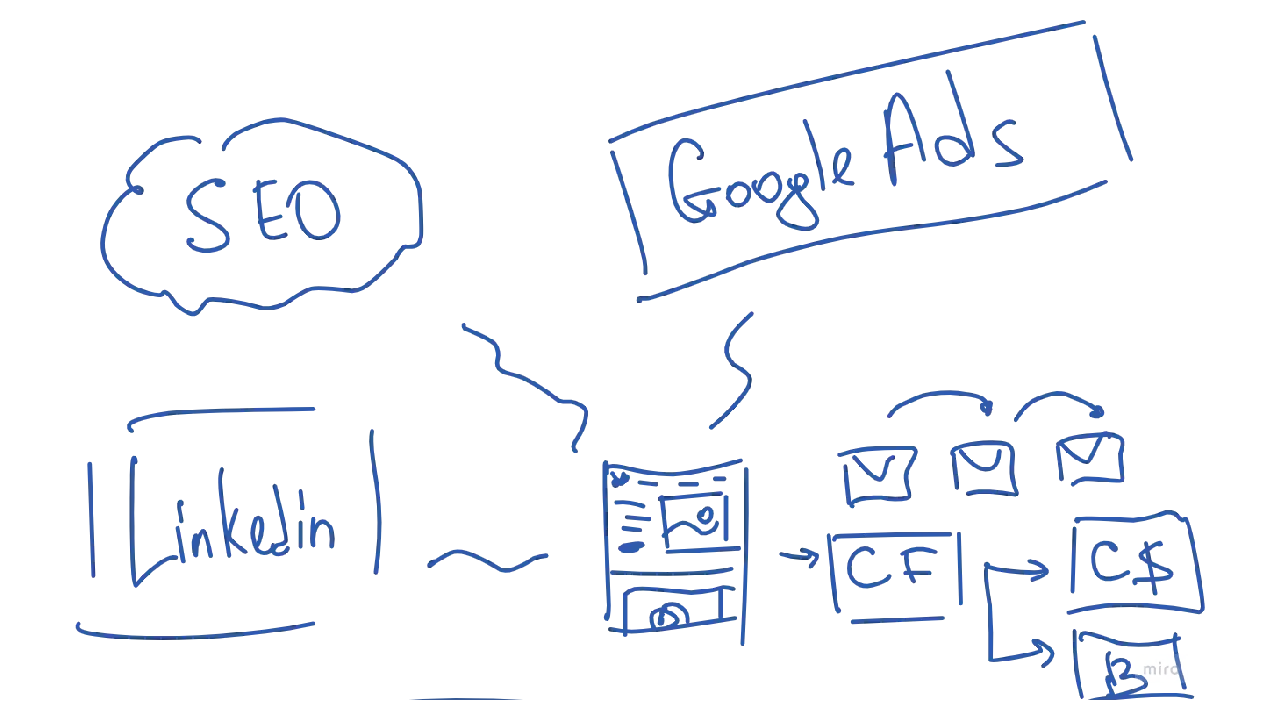 Channel selection is where founder intuition is wrong most often. The channel that feels obvious — the one every competitor is on, the one that’s currently trending — is rarely where a specific niche buyer is actually making decisions.
Why the Obvious Channel Is Usually the Wrong One
A channel is only worth using if it matches both the buyer’s platform habits and the format the decision actually gets made in. High-consideration, high-ticket B2B purchases rarely convert from short-form video — they convert from search intent, warm referrals, and communities the buyer already trusts.
Mapping Channels to Real Buyer Behavior
For most B2B and niche offers, that means two channels are close to mandatory — SEO for buyers already searching for a solution, and paid search for buyers ready to act now — plus one or two channels specific to where that exact audience already gathers, whether that’s a professional community, a partner network, or an industry directory.
Step 7: Forecasting Growth With a 13-Month BFM Model
BFM is the month-by-month financial model that turns your funnel assumptions into a 13-month revenue and profit forecast, tied directly back to the SUP break-even numbers and the ABCR price list.
 Month One Is Supposed to Look Bad
A credible BFM model shows month one at or near zero revenue — funnels take time to mature, and a model that shows strong sales from day one is a model nobody serious will trust. Investors read a deliberately conservative first month as a sign the rest of the numbers are honest too.
Two Growth Hypotheses: Base and Scaled
Every BFM model should show two paths: what the current team can realistically achieve, and what becomes possible with reinvestment. Showing only the ambitious number without the base case reads as wishful thinking; showing only the base case undersells the opportunity.
Hypothesis 1 – Organic Growth With Your Current Team
A conservative ramp across your core channels, run by the team you can actually afford on day one, usually clearing initial profitability within six to eight months.
Hypothesis 2 – Scaling Through Automation and New Markets
The reinvestment path: automation that lets the same team handle more volume, expansion into adjacent markets or geographies, and a larger paid budget funded by profit already earned — not by outside capital alone.
How an Expat in London Built a B2B Pastry Empire in the Czech Republic
[based on true story, some names and events changed, you can find few of our 200+ cases here]
In 2022, Andrea moved from Ukraine to London with a simple dream: creating custom cakes for local celebrations. However, the London consumer market was saturated with local bakeries, high rent costs, and low margins. According to market research, over 60 percent of small consumer bakeries fail within their first two years due to unpredictable retail traffic.
Realizing that reliance on single retail transactions was financially unsustainable, Andrea shifted her go-to-market strategy focus entirely toward corporate clients and wholesale buyers across Europe, ultimately establishing a high margin enterprise in the Czech Republic while remaining based in the United Kingdom.

Building an international B2B brand remotely required a structured framework rather than guesswork. Andrea applied the City Profit methodology to transition from a local cake maker to a primary B2B pastry supplier for corporate events, luxury hotels, and high end coffee chains across Prague and Brno. As modern B2B growth expert Aaron Ross once noted, predictable revenue is not built on random social media posts, but on systematic, repeatable sales frameworks. By aligning her market validation, core offer, pricing metrics, product architecture, break even math, channel selection, and financial modeling, Andrea transformed a fragile baking hobby into a scalable cross border corporation.
Step 1: Defining a Specific B2B Niche and Validating Czech Demand
Andrea initially attempted to sell premium celebration cakes to anyone needing a dessert. This generic positioning forced her to compete on price against hundreds of established home bakers. To build a defensible business model, she narrowed her target niche down to corporate event planners, boutique hotel chains, and premium coffee shops in major Czech cities that required consistent, non perishable, allergen friendly luxury pastry sets for corporate gifting and daily catering.
Analyzing Search Data and Pre Selling Before Production
Before investing in industrial kitchen equipment or localized branding, Andrea analyzed search trends across Central Europe. Google search volume data indicated a 45 percent increase in demand for premium white label corporate catering solutions in Prague compared to pre 2022 metrics. To validate this demand without launching expensive ad campaigns, Andrea pre sold custom tasting kits directly to corporate procurement managers. Securing three advance contracts validated that business buyers were willing to pay premium rates for reliable, scheduled pastry deliveries, confirming product market fit before capital outlay.
Step 2: Engineering a High Converting Core Offer
Andrea recognized that corporate buyers do not buy cakes based on artistic design alone; they purchase reliability, administrative convenience, and brand prestige. To stand out, she structured her primary value proposition around the City Profit Core Offer formula: We provide automated, white label luxury pastry sets for corporate events in the Czech Republic, so you can impress high value clients, even without a local pastry chef or complex logistics.
Now THAT is proper Go-to-market strategy.
Refining Technical Specifications and Emotional Outcomes
The technical aspect of her offer specified guaranteed delivery timeframes, certified shelf life parameters, tax compliant invoicing, and customizable corporate branding options. The emotional outcome promised event coordinators freedom from vendor delays and full protection of their firm reputation. As sales author Stephan Schiffman stated, businesses do not buy products, they buy solutions to operational friction. By addressing the buyer silent fear of logistical failure, Andrea eliminated the primary barrier to closing corporate contracts.
Step 3: Calculating Value Based Pricing with the POSCO Scorecard
Initially, Andrea priced her luxury cakes by adding a standard markup to raw ingredient costs. This approach resulted in razor thin profit margins that could not absorb international shipping fees or white label packaging costs. To set a defensible, profitable price, Andrea utilized the POSCO framework, scoring her brand against four local Czech competitors across five distinct pillars: Product, Online presence, Service, Cost brand equity, and Offline presence.
Adjusting Prices to Match Brand Equity Realities
The POSCO analysis revealed that while her product quality and service response speed scored higher than local legacy suppliers, her brand equity score was near zero due to her lack of market history in Prague. Instead of dropping prices to compete with lower tier suppliers, Andrea bundled additional value into her offer. She added complimentary custom branding on packaging, dedicated account support, and guaranteed emergency replacements. This strategy justified a price point 30 percent higher than local market averages while maintaining a strong value proposition for enterprise clients.
Step 4: Designing an ABCR Product Ladder for Margin Expansion
Relying on a single product tier created severe cash flow volatility. Andrea restructured her catalog into an ABCR product architecture to diversify revenue streams, improve client retention, and optimize customer acquisition costs.
Structuring the Four Product Tiers
Free Lead Magnet (CF Tier)
A downloadable digital catalog and corporate catering guide titled The Executive Event Planner Guide to Luxury Pastry Logistics, designed to capture contact details of event managers across Prague.
Low Ticket Trust Builder (C$ Tier)
A paid corporate sample kit featuring six micro pastry selections delivered directly to corporate offices for a nominal fee, allowing prospects to test quality with minimal financial commitment.
Core Offer (B Tier)
Recurring monthly catering contracts for corporate offices and recurring hotel pastry supplies, priced for maximum profitability using POSCO metrics.
Premium and Recurring Upgrades (A and R Tiers)
Fully customized, exclusive pastry sculptures for major annual galas alongside automated weekly subscription refills for premium coffee shop networks across Central Europe.
Step 5: Establishing Financial Stability with SUP Break Even Calculations
Operating a business remotely from London required absolute clarity on monthly fixed operational overhead. Andrea implemented the SUP model to determine her exact start up costs, fixed monthly expenditures, target payback schedule, and gross margin per order.
Differentiating Fixed Overhead from Variable Production Costs
Andrea separated her fixed costs (virtual office maintenance, B2B software subscriptions, cold storage lease, remote account management) from flex costs (raw ingredients, specialized packaging, localized delivery logistics). By calculating her exact contribution margin per corporate contract, the SUP model demonstrated that she needed precisely eight recurring corporate accounts per month to achieve operational break even, removing financial guesswork from her growth strategy.
Step 6: Executing Targeted B2B Channel Selection
Andrea initially wasted time posting consumer focused cake photos on Instagram, which yielded high engagement from retail followers but zero corporate contracts. Recognizing that high ticket B2B buyers do not make procurement decisions based on short form video content, she reallocated her go-to-market strategy toward channels with explicit commercial intent.
Focusing on High Intent B2B Acquisition Channels
Search Engine Optimization (SEO)
Andrea optimized her web portal for Czech commercial search queries related to corporate catering, wholesale pastry supply, and white label hotel desserts, capturing active demand.
Direct B2B Outreach and LinkedIn Networking
She built direct lines of communication with corporate procurement heads, luxury hotel general managers, and event agencies across Prague and Brno, establishing direct commercial partnerships.
Step 7: Scaling Revenue with a 13 Month Financial Model
To plan long term expansion and secure trade financing, Andrea developed a conservative 13 month financial forecast based on two distinct growth hypotheses.
Analyzing Base Growth vs Automated Scale
Hypothesis 1: Base Organic Growth
Assuming direct sales efforts by a lean team, the model projected gradual client acquisition, reaching consistent profitability by month seven with a portfolio of fifteen active corporate accounts.
Hypothesis 2: Scaled Automation and Regional Expansion
By reinvesting early profits into automated order processing systems, search engine marketing, and logistics partnerships, the business scaled across additional Czech regions, tripling monthly recurring revenue by month thirteen.
As marketing strategist Dan Kennedy famously observed, the business that can afford to spend the most to acquire a customer wins. By applying structured GTM CITY PROFIT frameworks, Andrea built a resilient B2B enterprise in the Czech Republic while operating comfortably from London, proving that systematic strategic execution outperforms simple product enthusiasm every time.
How City Profit Builds Go-to-market strategy For You
City Profit is a digital sales systems agency built for small but powerful underdogs — B2B and niche businesses that need a predictable growth architecture, not a template. We don’t run mandatory frameworks for their own sake; every model is built from first principles and reflects the exact strategy, pricing, product architecture, funnels, growth mechanics, and investor narrative we’d use if the business were ours. Yep. You heard it right. Go-to-market strategy is the thing we do not only for you as a customer, but for us as integrators (have a look at our portfolio)
 Depending on where you are, that can mean:
- A free Live Audit of your niche, Core Offer and productology — or a look at your competitors if you don’t have a website yet.
- THE MODEL — Niche, Core Offer, POSCO analysis, revenue forecasting, productology and funnel mapping, delivered as an investor-ready pitch deck and financial model.
- Digital System 1.0 — everything in THE MODEL, plus brand identity and a launch-ready landing page.
- Fractional CMO / PM — ongoing, hands-on management of your digital growth once the system is live.
We’ve built more than 200 businesses this way, from a first sketch on a whiteboard to their first 100 customers.
Want the Full Go-to-market strategy Framework in One Document?
Download The Business Model Playbook — the complete Niche, Core Offer, POSCO, ABCR, SUP and BFM sequence, laid out so you can run it on your own idea this week.
Get The Business Model and go-to-market strategy Playbook
Frequently Asked Questions about City Profit GTM
What is a Core Offer, exactly?
The one sentence your business is known for — the specific promise a client should be able to repeat to someone else in about twenty seconds, without your help.
Is POSCO only useful for pricing in go-to-market strategy?
Pricing is the most visible output, but the same scoring exercise also shows exactly which pillar — product, online presence, service, brand, or physical presence — is worth improving first.
Do I need all four ABCR layers on day one?
No. Most founders launch with the free magnet and the core offer, then add the premium and recurring layers once the core product is proven and margin needs to be improved.
How long does it take to build a model like this?
A focused version can be built in a matter of days once the niche is set — the slow part is almost always founders second-guessing the niche, not the math itself.
Can this framework work outside of legal or professional services?
Yes — the same six steps apply to any B2B or niche consumer offer; only the weighting inside POSCO and the specific channels in the funnel change from industry to industry.